Three Chillies with Classic CredentialsChillies every serious grower should know.
Three Chillies with Classic Credentials
Chillies every serious grower should know.
At World of Chillies, the job has always been the same: to grow and showcase the best chillies from around the world.
Over time, some varieties earn their status not through novelty or hype, but by being consistently good — good to grow, good to cook with, and good to come back to year after year.
That’s how chillies like habaneros and jalapeños became classics. They worked, and they kept working.
This year I’m starting with three chillies that sit firmly in that tradition. They aren’t new releases and they aren’t fashionable curiosities, but they’re classics in the making — proven plants with real flavour, strong character and serious potential.
You may not see them everywhere, but they’ve earned their place. These are the sort of chillies I’ve always grown, for a simple reason: they’re just plain good.
Click on the icons below for more information.



-

Datil ripens directly from green to yellow-orange, with no intermediate colour stage.
-

Plants set fruit in tight clusters, giving steady harvests rather than sudden gluts.
-

Thick-walled, juicy pods are ideal for sauces, ferments & vinegar-based blends.
-

Short, blunt-ended pods with a clean sheen look particularly good once bottled.


Datil is closely associated with north-east Florida, particularly the St Augustine area, where it became established after Minorcan settlers were brought over in the late 18th century to work on British colonial plantations. When those plantations failed, many settlers moved to St Augustine and stayed. Datil travelled with them and became a local staple rather than a commercial export crop.
In that context, Datil has traditionally been used fresh or fermented, often chopped directly into stews, seafood dishes and vinegar-based sauces. The region still has a strong culture of Datil pepper sauces — usually thin, sharp and functional rather than sweet — made for everyday use rather than show. It’s a chilli that entered cooking quietly and stayed there.
Heat is usually quoted at 100,000–300,000 SHU, but Datil isn’t prized for extremes. What matters is the structure of the pod. The walls are relatively thick, the flesh is juicy, and the flavour — fruity with a distinct citrus edge — remains present after fermentation or dilution. That combination is the reason it works so well in sauces: it contributes flavour as well as heat, and doesn’t collapse under vinegar, salt or ageing.
From a growing point of view it’s cooperative. Plants crop steadily rather than all at once, and pods ripen directly from green to a strong yellow-orange. When the plants are loaded, the colour is striking — clusters of clean, saturated fruit that look exactly as they should.
That makes timing easier and avoids the glut-and-panic cycle that comes with more aggressive varieties. For small-batch sauce making, those traits are more useful than raw productivity.
Datil isn’t rare, fashionable or genetically extreme. It’s a regional chilli that proved itself in a specific place and stuck around because it was useful.
-

Long, lightly twisted pods are typical of traditional Indian green chillies.
-

Plants grow tall and loose, producing fruit across a wide, unstructured frame.
-

Pod shape varies naturally, with straight and curved fruits on the same plant.
-

Best used green, where the heat is sharp and the flavour stays bright.
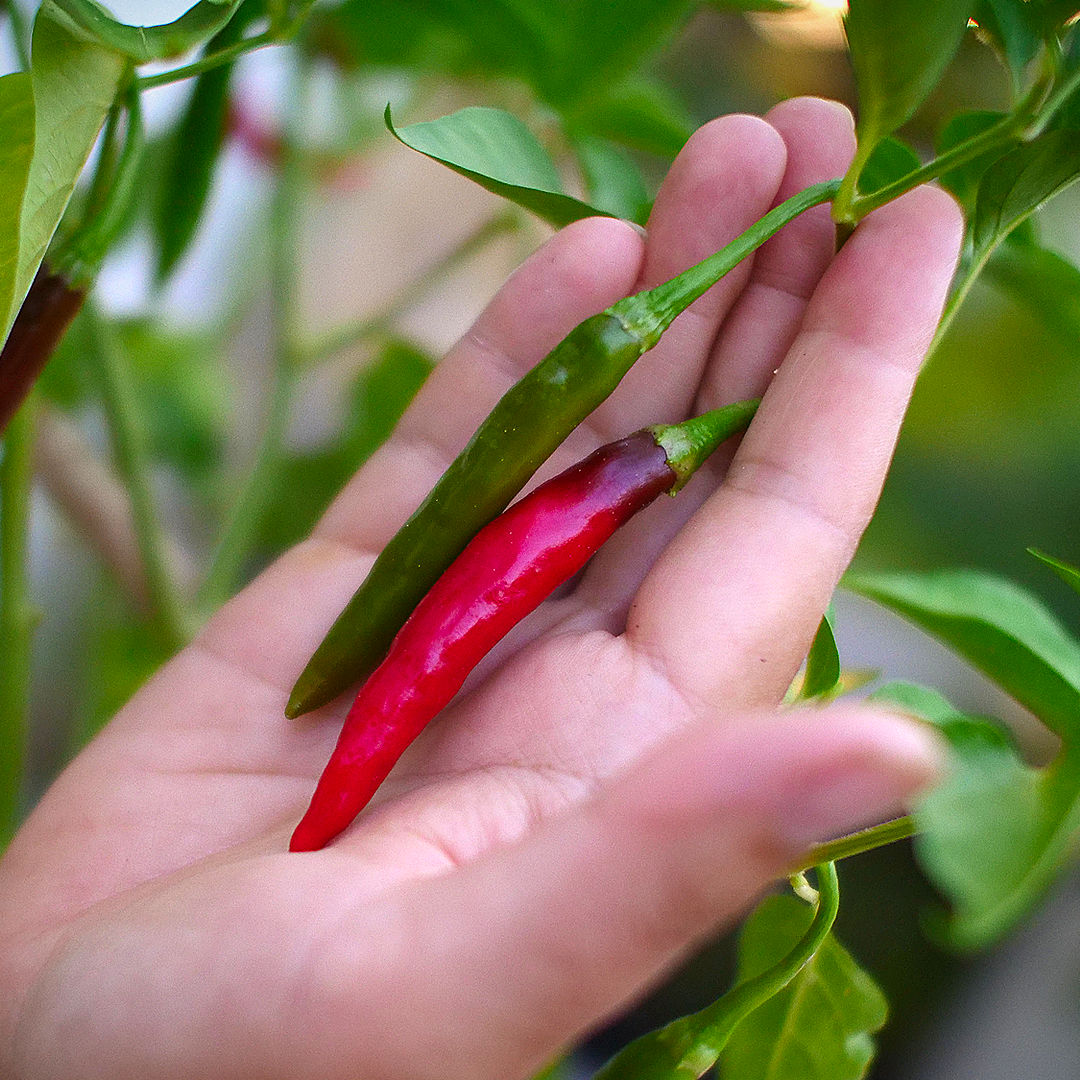


Pusa Jwala is an older Indian green chilli that predates many of the compact, high-yield hybrids now widely grown. In recent years I’ve mostly moved over to modern types like Vindaloo, which are easier to manage and very productive.
What I don’t know — and what I want to find out — is whether that shift came at any cost in flavour, and whether an older chilli like Pusa Jwala might behave differently over a longer season.
I grew it about four years ago and remember it as unruly. The plant sprawls and sends branches in all directions, with pods appearing wherever they happen to form rather than in neat clusters. It looks untamed, but it’s busy. The pods are long and irregular, with gently curved, wobbled sides rather than the straight, uniform shape you see in many modern hybrids. It’s a plant that hasn’t been trained to look orderly.
Pusa Jwala was bred at the Indian Agricultural Research Institute as a green chilli for everyday cooking. Heat usually sits around 20,000–40,000 SHU, which puts it firmly in daily-use territory. Used green, the flavour is sharp and vegetal, designed to be cooked fresh — slit and fried in oil, chopped into dals, or added whole to vegetable dishes. It isn’t a chilli you ration or build a dish around; it’s one you reach for repeatedly.
What I’m interested in this time is how long it keeps going. Modern hybrids tend to come hard and fast, then tail off. From memory, Pusa Jwala held onto pods well and continued producing if it was picked regularly.
If that proves to be the case again, it would mean having fresh green chillies available later in the year, rather than falling back on supermarket fruit that’s often bland and tired. That’s the question I’m growing it to answer.
-

Pea-sized pods pack intense aroma, harvested individually rather than in bulk.
-

Plants form dense shrubs, heavily studded with fruit when conditions suit them.
-

Pods ripen cleanly from green to a rich gold, without passing through orange.
-

Dry-skinned berries are used sparingly, but leave a lasting impression.
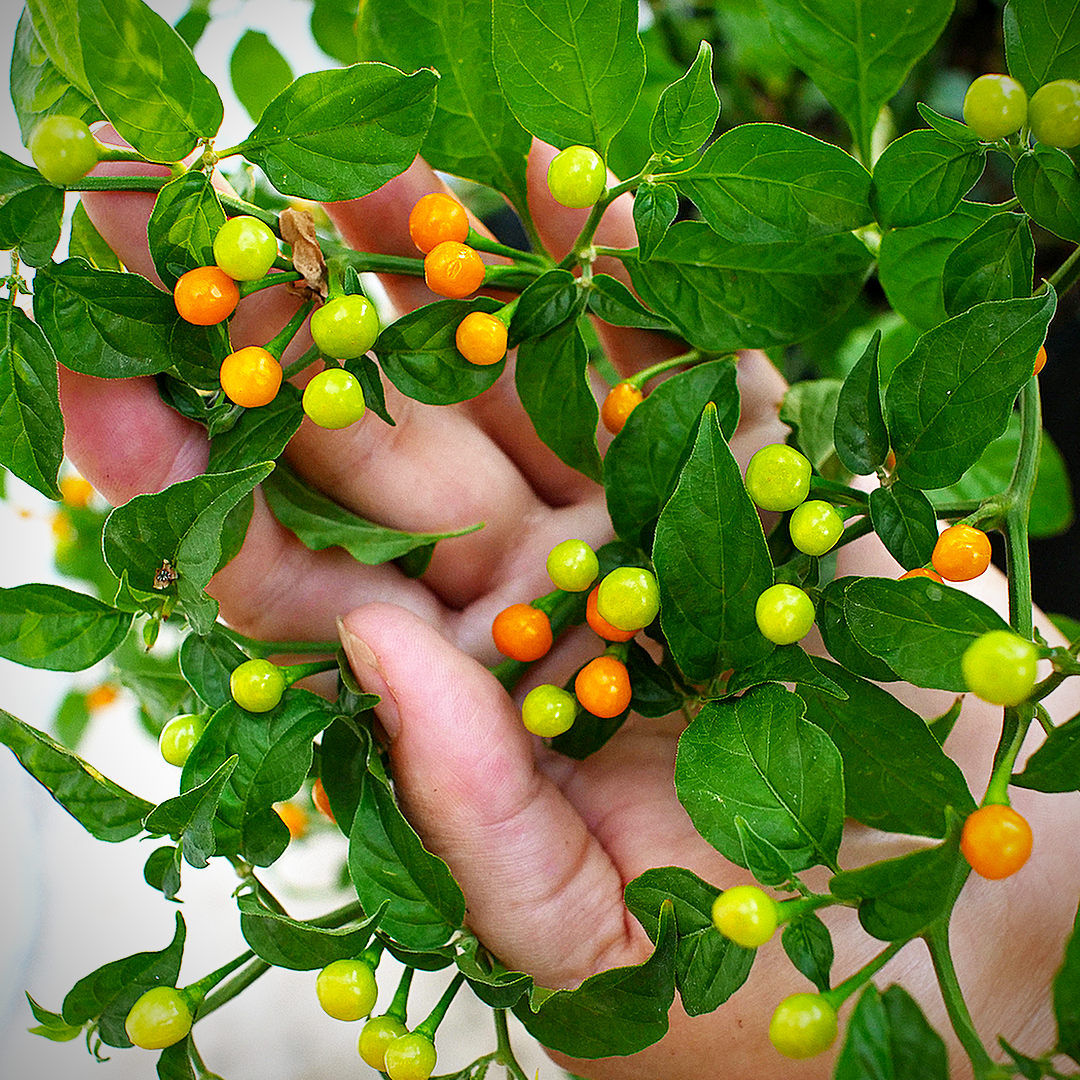


I grew Charapita once, about six or seven years ago, and it’s stayed with me ever since. It’s one of those plants that doesn’t shout for attention but quietly steals the show. The fruits are tiny — little round beads — and when they ripen from green to a clear, glowing orange they’re honestly breathtaking. It’s still one of the most beautiful chillies I’ve ever grown.
Since then, I’ve tried again and again to get it going, with no luck at all. Poor germination, weak seedlings, whole batches that went nowhere. Charapita has a reputation for being difficult, and in my experience it earns it. So finding a reliable seed source at last feels like finally getting another chance with something unfinished.
Charapita comes from the Peruvian Amazon and is often described as one of the most expensive chillies in the world — not because it’s flashy, but because it’s slow, awkward and doesn’t give much away easily.
The heat sits somewhere around 50,000–100,000 SHU, but what matters far more is the flavour: bright, fruity and aromatic, with a clean heat that sharpens a dish rather than overwhelming it. It’s a favourite with chefs for exactly that reason.
This is a chilli I grow for pleasure as much as purpose. And if the summer behaves itself like it did last year, my Christmas presents are already more or less decided — A Charapita-based sauce should provoke a level of excitement entirely out of proportion to its size.
I’ll be growing all three of these again this year. If they behave as expected, they’ll make their way into the shop in plug form — so if you fancy growing along, keep an eye out. I’ll share the odd update as the season gets going.
World of Chillies was set up by Sarah Hunt in 2011 to promote chilli growing and the enjoyment of everything hot and spicy.
UK Company No. 07860204.
VAT reg. 223126942