7 Pot BubblegumThe Bleeder: Fruity, Fiery & Slightly Deranged
7 Pot Bubblegum: Fruity, Fiery & Slightly Deranged
The stem flushes red before the pod is ripe, as if the heat has started leaking early.
The name was absurd enough to justify sowing it. That’s how these things usually begin. The 7 Pot Bubblegum arrived during the tail end of the superhot arms race—an era in which every week seemed to bring a new contender for “World’s Hottest,” each with a name more cartoonishly aggressive than the last.
I was, by then, a little scorched by it all. I’d seen the Scorpions, the Reapers, the Primos and the Brains. One cultivar was even called JAFSH—short for “Just Another F***ing Superhot,” which at least had the decency to say what we were all thinking. I haven’t grown that one yet, but I admire its honesty.
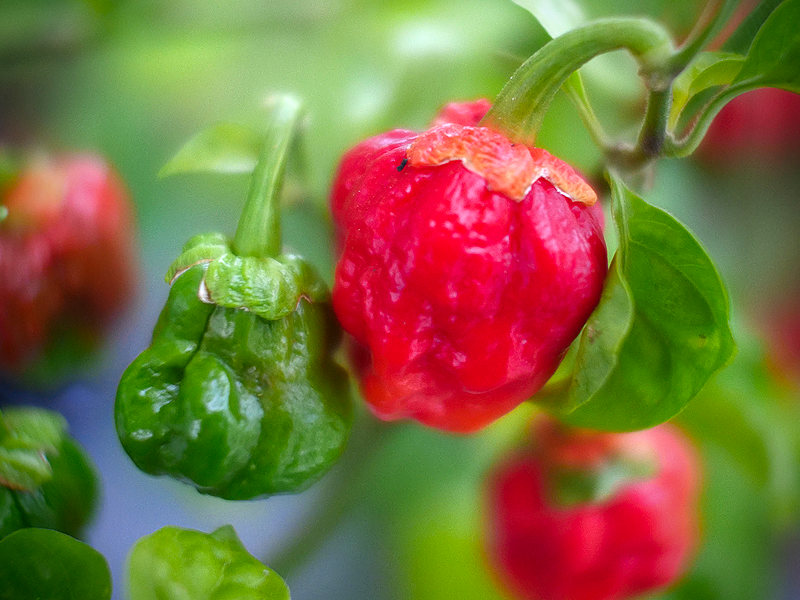
The flush creeps from the pod, marking the stem with fire before the fruit is ripe.
I didn’t expect much from the Bubblegum. I wasn’t even sure why it was called that—something to do with the colour, I assumed, or perhaps irony. It sounded like a joke. But I sowed a few seeds out of curiosity and tucked them away with the others, half expecting them to sulk in the corner and quietly die of heat exhaustion like many of their high-Scoville cousins. But they didn’t. They got going fast—surprisingly fast—and set about growing with the kind of vigorous, slightly indecent enthusiasm one doesn’t expect from a superhot.
The flowers were striking—frilly, blushed with pink—and when the calyxes began to form, I had to stop and stare. Unlike any other chilli I’d grown, the calyx didn’t just cradle the fruit, it seemed to engulf it, bleeding its colour down the stalk in a brilliant, glossy red. The effect was unnerving. It was as if the pods had ruptured and were leaking dye into the stems. They looked radioactive. Or carnivorous. Or possibly both.
There’s something gloriously misleading about the way this plant looks. The pods themselves—plump, rounded, sometimes with a little pucker at the tip—have a cartoonish, almost comical appearance. A sort of mutant strawberry, drawn by a child on a sugar rush.
There’s something gloriously misleading about the way this plant looks. The pods themselves—plump, rounded, sometimes with a little pucker at the tip—have a cartoonish, almost comical appearance. A sort of mutant strawberry, drawn by a child on a sugar rush.
Set against the lush, apple-green foliage, they make the whole plant look like a hallucination. It was beautiful in a slightly deranged way. And every time I walked past it, it made me laugh—which is not something I usually expect from a chilli plant. Danger and charm aren’t often found together in nature, but here they were, arm in arm.
7 Pot Bubblegum: The Bleeder
▶ Heat (Hotness): 9. The 7 Pot Bubblegum doesn’t just burn — it oozes menace. The heat is not an attack; it’s a slow, deliberate haunting. It arrives through the back door and quietly starts rearranging the furniture of your nervous system. Like standing in a field moments before lightning strikes, the air charged with dread and inevitability. The pain climbs steadily, inexorably, until you're beyond tears, beyond words, beyond self. It is not a chilli to eat. It is a trial to endure.
▶ Sweetness: 5. There is sweetness here, yes — but it is the sweetness of betrayal. A sticky, cloying undertone that draws you in like the scent of overripe fruit in a predator’s den. It is not cheerful or bright, but strange and unsettling — like finding a boiled sweet in the pocket of a war veteran’s coat. The flavour is jammy, resinous, vaguely tropical — a guava that’s been left too long in the sun and is now fermenting gently in its own guilt. You will taste the sugar, but you will not trust it.
▶ Fruitiness: 7. The fruit is lush, but it feels contaminated — like something beautiful that’s seen too much. Think strawberries macerated in trauma, or a mango with a haunted past. There’s a distinct note of red bell pepper, overlaid with scorched papaya and perhaps a whisper of stewed plum — all of it lurking beneath that tell-tale metallic shimmer of danger. It is not the fruit of paradise. It is the fruit of a ruined Eden, growing wild through cracks in the temple floor.
▶ Texture (Firmness): 6. The pod is thick-walled and unyielding, with a skin like an exoskeleton and flesh that resists your teeth just long enough to make you regret your decision. Bite down, and it splits open like a pomegranate of wrath. The placenta is swollen and strangely beautiful, like something you might find growing under glass in a Victorian curiosity cabinet. It does not wish to be eaten. It wishes to be feared.
▶ Juiciness: 4. There is juice, but it is not refreshing. It is more sap — thick, slightly sticky, and redolent of latex and unspoken warnings. If this chilli bled, it would bleed red. Not metaphorically, but literally — its defining trait is that its scarlet pigment bleeds up the stem, staining the calyx as if the plant itself has ruptured. You do not wipe this juice away. You live with it.
▶ Aftertaste (Complexity): 9. Once the fire dies down (assuming it ever does), you’re left with a complex web of flavour memories. Earth, rust, dried hibiscus, the ghost of cinnamon bark, and something like spent matches. It lingers long after the pain, whispering to your tastebuds like an ancient tale of vengeance. You don’t so much remember the flavour as wake up from it — wondering what happened and whether you’re entirely the same.
At the time, I wasn’t really eating superhots. I gave most of the harvest away to friends—those with asbestos tongues and a taste for extremes—but I never forgot the Bubblegum. I am growing it again this year, this time with more interest in how to actually use it.
Because here’s the thing: buried beneath the fire and fury is a genuinely complex, fruity flavour—one that reminds me faintly of guava and tropical juice, if you can get past the initial sense that your face is melting. It clocks in at well over 800,000 Scoville Heat Units, sometimes more, depending on conditions—so it’s not messing about—but it’s strangely moreish once you know how to handle it.
Botanically speaking, the 7 Pot Bubblegum is a strange and slightly controversial character. It’s a cross between a Trinidad 7 Pot and a Moruga strain, with the unusual red calyx trait likely inherited from a variant of Moruga Scorpion.
This ‘bleeding’ calyx is the thing that makes it stand out—even among the baroque world of superhots—and is one of the reasons it’s still so widely grown despite its punishing heat. It doesn’t just produce fruit, it stages a performance.
There’s no deep culinary tradition behind this chilli—it’s a relatively recent invention, part of the experimental explosion that came when growers began freely crossing Capsicum chinense lines for heat and visual drama.
But I sometimes imagine what a pepper like this would have meant to the early Amerindian growers of the Caribbean, who cultivated the first chinense chillies in Trinidad and Tobago’s humid forests thousands of years ago. They didn’t have Instagram, of course, or hot sauce competitions. But they did understand beauty, flavour, and the slow art of growing things with power.
These days, I’ve made peace with the superhots. I’m not about to chomp one raw, but I’ve found ways to use them in moderation—blended into sauces with fruit, slow-cooked into jams, even steeped in oil, where the flavour infuses without the full incendiary blast.
The Bubblegum, with its Moruga and 7 Pot parentage, would make an astonishing sauce—fierce, yes, but rich and unmistakably tropical. Bubblegum sauce sounds absurd, but with the right blend—mango, papaya, maybe a touch of lime—it could be genuinely delicious. The kind of thing you might bottle up and give to someone at Christmas. If only to watch their face. It’s not just another f***ing superhot. It’s a plant with character. And this year, I will try JAFSH too— for the sauce and the story.
World of Chillies was set up by Sarah Hunt in 2011 to promote chilli growing and the enjoyment of everything hot and spicy.
Chilli Plants
Tomatoes
Chilli Seeds
Delivery Info
About Us
Contact Us
Sign Up Chilli Club
Privacy
Terms & Conditions
▶ 1. Heat (Hotness): The defining characteristic for most people. Is it mild, medium, or hot? How does the heat develop—immediate or lingering?
▶ 2. Sweetness: The balance of natural sugars. Some chillies have a sweetness that complements their heat and makes them versatile in cooking.
▶ 3. Fruitiness: The aromatic, flavour-forward profile. Does it taste tropical, citrusy, or like berries? This quality often gives chillies their distinctive edge.
▶ 4. Crunchiness or Firmness (texture): Freshness matters. Is the chilli crisp and crunchy, soft and pliable, or somewhere in between?
▶ 5. Juiciness: How much moisture does the chilli release when bitten into? This can influence its suitability for fresh eating or cooking.
▶ 6. Aftertaste (Complexity): What lingers after the initial bite? Is there a smokiness, an earthiness, or a clean, simple finish? This separates "nice" chillies from truly memorable ones.
▶ Schedule of Dispatches . We’re pleased to let you know that we’re preparing to dispatch our first plug plants!. Please follow the link for a rough schedule, but please note that we’ll send your order once everything in it is ready. This ensures you receive the best possible plug plants—so if there’s a slight delay, rest assured you haven’t been forgotten. ▶ MORE INFORMATION