
The Original Wild Chilli
The Original Wild Chilli
Before Jalapeños, before Habaneros- Mexico had Chiltepin, the mother of all chillies.
Before the Carolina Reapers and the Habaneros, before Jalapeños became the global mascot of spiciness, before humans even thought to cultivate chillies, there was the Chiltepin.
A wild, untamed ember of a plant, growing wherever nature pleased, utterly indifferent to human culinary ambitions. And yet, without it, we might not have the thousands of cultivated varieties we have today.
Every hybrid, every monstrous superhot, every mild, fleshy bell pepper owes its lineage to this tiny, fiery ancestor. It is, in short, the Eve of chillies, though significantly less accommodating.

The original chilli still thrives today in Mexico's Sonoran Desert.
It’s a bit of a travesty that I’ve only grown it once. But this year, I intend to rectify that mistake. I didn't expect much when I first grew it. Wild chillies, in general, can be oddities—nice as collector’s pieces, fascinating from a botanical perspective, but not necessarily standouts in the kitchen. The Chiltepin, however, is different. Right from the start, the seedlings emerge with a peculiar, frilly elegance, their leaves distinct enough that even among a sea of chilli seedlings, they announce themselves with quiet confidence. And once mature? Absolutely stunning.
When you bite into a Chiltepin, you are tasting the first step in the domestication of wild chillies, the very moment when early humans realised that these fiery little beads could add excitement (and possibly mild regret) to their meals.
The plant forms a dense, shrubby mass, a feral relative of modern cultivars, with tiny, bright green globes that turn to a pure, almost theatrical red. Unlike the showboating modern chillies, these pea-sized pods don’t demand attention—they simply exist, in great abundance, waiting for their moment. And what a moment it is.
The flavour? Frankly, not much to speak of. It is a sharp, clean burn, an immediate sting rather than a slow smoulder—a tiny, botanical assassin that lands its hit and vanishes, leaving only the memory of fire. It does not linger, nor does it offer the floral complexity of a Habanero or the citrus kick of a Lemon Drop. What it does have, however, is a sense of history.
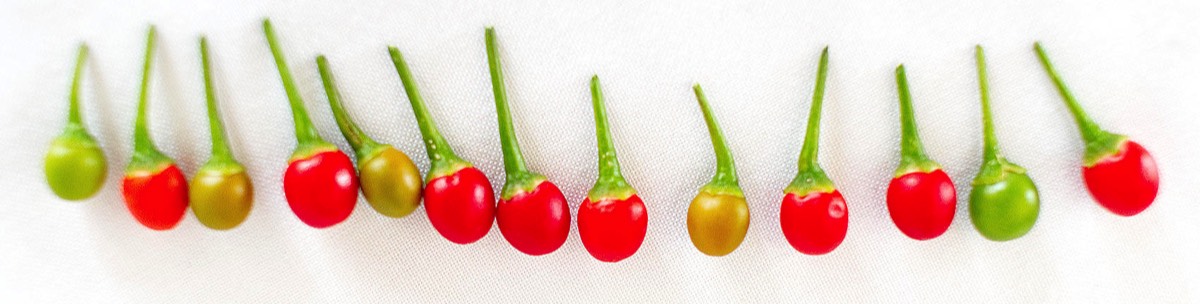
When you bite into a Chiltepin, you are tasting the first step in the domestication of wild chillies, the very moment when early humans—likely in present-day Mexico or the southwestern U.S.—realised that these fiery little beads could add excitement (and possibly mild regret) to their meals.
The Seri people of Sonora, one of the many indigenous groups to have revered the Chiltepin for centuries, call it "the pepper of the bird", because birds—immune to capsaicin—scatter its seeds far and wide, ensuring its continued reign as the original untamed chilli. In Mexico, it is known as El Oro Rojo—Red Gold—not just for its colour but for its historical and cultural significance.
Flavour Profile
🌵 Heat (Hotness): 5. The Chiltepin does not believe in foreplay. There is no slow-building seduction, no gradual ascent towards heat. No, this mini firebrand operates on the principle of instant, sharp betrayal—like being nipped by a tiny but ill-tempered creature you were foolish enough to admire up close. Not a grudge-holder, this one—more a mischievous trickster that slaps you and vanishes before you can retaliate.
🌵 Sweetness: 1. There is nothing remotely sweet about the Chiltepin. It is about as sweet as a desert vulture or an ancient warrior who has never once smiled. This chilli has survived generations of scorching sun and predatory birds, and it does not care for your palate’s comfort. Any illusions of sugariness are dashed the moment it hits your tongue, delivering a flavour that speaks of hardship and survival, of sand-worn bones and the echoes of distant thunder.
🌵 Fruitiness: 4. There is a memory of fruit, but it is the fruit of harsh lands—the kind that grows in the cracks of ancient rocks, fought over by creatures with sharp beaks and mean dispositions. If there is a fruitiness here, it is dry, sharp, and vaguely reminiscent of something that once had moisture but has long since forgotten what it felt like. There’s a whisper of sun-dried tomato, a fleeting wisp of smoked raisin, but mostly, there is a sense that this chilli has spent its life in the company of dust storms.
🌵 Texture (Firmness): 7. The Chiltepin is small but unreasonably defiant. It is not soft in any way accommodating. Instead, it is a tiny, armoured sphere, designed by nature to resist all but the most determined of bites. Fresh, it is a crisp little grenade of pain. Dried, it transforms into a peppercorn of destruction, ready to shatter under pressure and scatter its incendiary fragments with the precision of a well-trained assassin. If chillies had a cavalry, this one would be riding a particularly aggressive stallion, brandishing a spear.
🌵 Juiciness: 1. Juiciness? Don’t be ridiculous. The Chiltepin is the chilli equivalent of a desert prophet, gaunt, weather-beaten, and utterly disinterested in luxury. Bite into a fresh one, and you’ll find only the faintest trace of vegetal crispness before the heat detonates. Dried, it becomes an arid relic. If you seek refreshment, look elsewhere. Preferably somewhere with shade and a large pitcher of something very, very cold.
🌵 Aftertaste (Complexity): 6. Once the fire subsides—and this is an eventuality, not a certainty—you may detect the remnants of something bold, untamed, and slightly bewildering. The Chiltepin does not merely fade away; it lingers in the background like the last note of a battle hymn. What remains is the sensation of having survived something. You will not forget it. The Chiltepin does not allow itself to be forgotten.
Unlike commercial chillies, which thrive in neat rows under careful cultivation, the Chiltepin remains wild and willful, preferring to be foraged rather than farmed. Even today, families in Sonora and Sinaloa trek into the hills to collect these tiny powerhouses by hand, often using them in salsas so hot they could double as chemical weapons.
And what a salsa it makes. The Seri prepare salsa tamulada, a mix of fire-roasted Chiltepin crushed with a mortar and pestle, blended with lime and salt. Simple, devastating, addictive. Green Chiltepin pods are pickled in vinegar with garlic and oregano, a perfect antidote to blandness. There is something deeply satisfying about the way it can be added whole to a dish, like a seasoning grenade—one pod, a whisper of smoke, a sudden bite. It is a chilli for those who enjoy the element of chance in their meals.
One of the biggest surprises in growing Chiltepin was how effortlessly it preserves itself. The pods seem to dry naturally on the bush, as though they’ve decided to take care of the post-harvest process on their own. They were so attractive in their little clusters that I snipped entire branches and strung them over a ribbon, plucking a pod whenever I needed a controlled detonation of heat in the kitchen.
By December, many were still hanging there, untouched, until I realised they had accidentally become part of my Christmas decorations. If there is a chilli more festive, I am yet to meet it.
Is it the best chilli in the kitchen? Not really.
Is it the easiest to grow? Hardly—it’s a desert plant that sulks in damp conditions.
Would I grow it again? Without question.
Because this isn’t just any chilli. It is the chilli that made all others possible. A plant that still refuses domestication, still thrives in the wild, still produces tiny grenades of history and heat. A plant that belongs as much in an ethnobotanical museum as it does in your garden.
Grow the Chilli That Started It All!
🔥 This week, you can grow your own Chiltepin. Tiny, fiery, and steeped in history, this is the chilli that started it all. A true survivor, Chiltepin thrives with minimal fuss—just give it warmth, and it will reward you with a taste of Mexico’s wild heart.
World of Chillies was set up by Sarah Hunt in 2011 to promote chilli growing and the enjoyment of everything hot and spicy.
Chilli Plants
Tomatoes
Chilli Seeds
Delivery Info
About Us
Contact Us
Sign Up Chilli Club
Privacy
Terms & Conditions
▶ 1. Heat (Hotness): The defining characteristic for most people. Is it mild, medium, or hot? How does the heat develop—immediate or lingering?
▶ 2. Sweetness: The balance of natural sugars. Some chillies have a sweetness that complements their heat and makes them versatile in cooking.
▶ 3. Fruitiness: The aromatic, flavour-forward profile. Does it taste tropical, citrusy, or like berries? This quality often gives chillies their distinctive edge.
▶ 4. Crunchiness or Firmness (texture): Freshness matters. Is the chilli crisp and crunchy, soft and pliable, or somewhere in between?
▶ 5. Juiciness: How much moisture does the chilli release when bitten into? This can influence its suitability for fresh eating or cooking.
▶ 6. Aftertaste (Complexity): What lingers after the initial bite? Is there a smokiness, an earthiness, or a clean, simple finish? This separates "nice" chillies from truly memorable ones.
▶ Schedule of Dispatches . We’re pleased to let you know that we’re preparing to dispatch our first plug plants!. Please follow the link for a rough schedule, but please note that we’ll send your order once everything in it is ready. This ensures you receive the best possible plug plants—so if there’s a slight delay, rest assured you haven’t been forgotten. ▶ MORE INFORMATION