Tabasco: The Chilli That Conquered the WorldBehind the world's most famous hot sauce is a remarkable little chilli, a largely overlooked botanical species and more than 150 years of history.
Tabasco: The Chilli That Conquered the World
Behind the world's most famous hot sauce is a remarkable little chilli, a largely overlooked botanical species and more than 150 years of history.
Almost everyone knows Tabasco sauce. That little bottle with its red cap and diamond-shaped label has found its way into restaurants and kitchens all over the world. But how many people have actually seen the chilli that goes into it?
I've been growing Tabasco chillies for years, and they're rather wonderful plants in their own right. They produce masses of slender, upright fruits, ripening through pale yellow and orange to a beautiful bright red. They're also members of one of the least celebrated of the five main domesticated chilli species, Capsicum frutescens.
And behind that familiar bottle is a surprisingly interesting story, stretching from tropical America to the salt mines and oak barrels of Louisiana.
From Tropical America to Louisiana
All chillies originated in the Americas, where different species were domesticated long before Europeans arrived. Tabasco belongs to Capsicum frutescens, a species native to tropical America, with a natural distribution extending from South America through Central America and the Caribbean.
The name Tabasco comes from the Mexican state on the Gulf coast, although the precise history of the chilli variety is less clear.
What we do know is that by the nineteenth century, a small, hot, upright-growing pepper had made its way to Louisiana, where it would become the basis of one of the world's most successful condiments.
It was Edmund McIlhenny who made the connection famous. In 1868, on Avery Island in Louisiana, he began commercially growing peppers and producing the sauce that still bears the Tabasco name.
But there's much more to this chilli than its American success story.

Capsicum frutescens: The Forgotten Chilli Species
Most of the chillies we grow belong to just a handful of species. Capsicum annuum includes Jalapeños, Cayennes and sweet peppers, while Capsicum chinense gives us Habaneros, Scotch Bonnets and many of the superhots. Then there's Capsicum frutescens, a comparatively neglected group in the world of commercial chilli growing.
The name frutescens means 'becoming shrubby', and that's a fair description. These are often vigorous, branching plants with small, fiercely hot fruits that stand upright rather than hanging down.
Botanically, there are some interesting differences too. The flowers are generally white or greenish-white, sometimes appearing in small clusters, and the fruit has a distinctive cup-shaped calyx where it joins the stalk. Their close relationship with C. annuum has made their classification surprisingly complicated, although C. frutescens is recognised as a separate species by modern botanical authorities.
Most of the chillies we grow belong to just a handful of species. Capsicum annuum includes Jalapeños, Cayennes and sweet peppers, while Capsicum chinense gives us Habaneros, Scotch Bonnets and many of the superhots. Then there's Capsicum frutescens, a comparatively neglected group in the world of commercial chilli growing.
Tabasco isn't its only famous representative. The Brazilian Malagueta belongs to the same species, as do many of the small bird chillies found across the tropics. Some chillies known as piri-piri also belong to C. frutescens, although that name is used for different peppers in different countries.
What's particularly interesting is how widely the species has spread. Botanists have recorded C. frutescens growing outside cultivation in parts of Africa, Asia and the Pacific. In some places it behaves almost like a wild plant, thriving around settlements, gardens and disturbed ground. It's a species with a far bigger geographical story than its modest place in most seed catalogues might suggest.
Flavour Profile: Tabasco
Heat (Hotness): 6. Tabasco is a small chilli with a disproportionately high opinion of itself. At 30,000–50,000 Scoville units, it delivers a sharp, immediate heat with very little ceremony. Rather like an elderly colonel who has spent forty years waiting for someone to question his authority, it gets straight down to business. The warmth builds briskly, although it stops short of declaring martial law.
Sweetness: 3. There's a faint sweetness in a fully ripe Tabasco, but generosity isn't one of its defining characteristics. What little there is appears briefly before being bundled out of the room by the heat. Rather like a Victorian orphan permitted a second helping of gruel, it seems almost embarrassed by the indulgence.
Fruitiness: 4. Fresh Tabasco is bright, grassy and faintly fruity, without the perfumed extravagance of a Habanero. If the latter were a flamboyant opera singer arriving with seventeen pieces of luggage and a pet ocelot, Tabasco would be the stationmaster checking his watch and wondering whether the animal had a valid ticket.
Crunchiness: 5. Small, slender pods with thin walls and a firm skin that gives a modest snap when bitten. Nothing like the substantial crunch of a Jalapeño. More like snapping a very small twig, except that the twig immediately retaliates. A curious evolutionary strategy, but apparently a successful one.
Juiciness: 7. For such a small chilli, Tabasco contains a surprising amount of liquid, which is one reason it lends itself so well to sauces. It brings to mind a particularly unpleasant deep-sea creature that, when prodded, releases rather more fluid than its dimensions would suggest. Best not investigated in the presence of children.
Aftertaste (Complexity): 4. The initial grassy sharpness gives way to a persistent peppery warmth, with just a suggestion of fruit. Tabasco knows what it's good at and sees little reason to diversify. Like a provincial magistrate who has reached eighty without admitting to a mistake, it considers complexity a dangerous foreign invention, probably responsible for the decline of the Empire.
How Tabasco Chillies Are Used Around the World
In Brazil, Malagueta chillies are an important part of everyday cooking, often preserved in vinegar, crushed into sauces or used to season fish, beans and meat.
In parts of the Brazilian Amazon, they're also used in regional preparations such as jiquitaia, a dried chilli seasoning, and damorida, a pepper-rich broth traditionally served with fish or game.
In Mexico's Tabasco region, small wild chillies still have a place in local food traditions. Research among Ch'ol communities has documented several different types, including the C. frutescens chilli known as picopaloma.
These aren't necessarily the same cultivated Tabasco pepper we grow, but they show how much local chilli diversity exists beyond the familiar commercial varieties.
Across parts of Africa and Asia, related bird peppers are similarly used fresh, dried or preserved, often in small quantities because their heat can be considerable.
One characteristic I particularly appreciate about Tabasco is its clean, direct heat. The fruits are usually rated at around 30,000–50,000 Scoville Heat Units, considerably hotter than a typical Jalapeño but nowhere near the extreme heat of a superhot.
Fresh Tabasco chillies have a bright, sharp character, although the famous vinegary tang associated with the bottled sauce comes largely from the fermentation and vinegar rather than the fresh fruit itself.
The Little Bottle That Changed Everything

Upright, productive and perfect for containers.

Dense foliage and heavy fruiting — classic Tabasco form.

Pods ripen from pale yellow through orange to bright red.

Pods ripen from pale yellow through orange to bright red.

Crushed fresh chillies salted and ready for the first stage of fermentation.
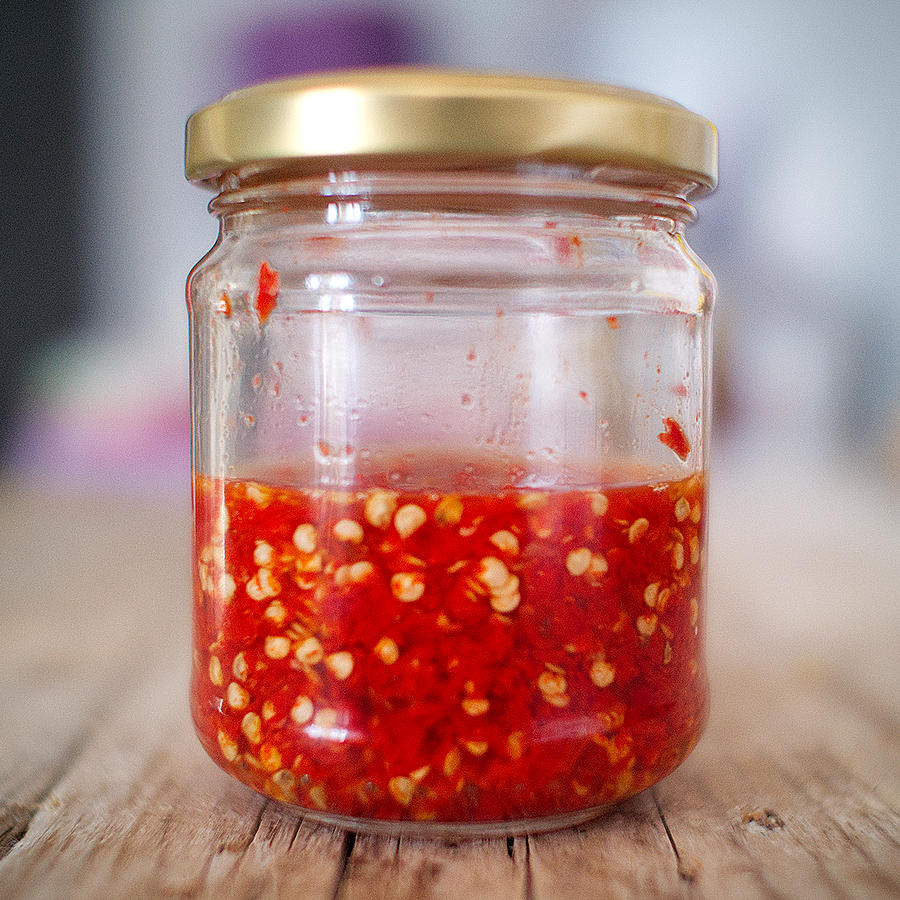
Tabasco chillies fermenting in brine — the start of their signature flavour.

The famous Tabasco sauce found worldwide.
But the manufacturing process is anything but ordinary. The peppers are harvested when fully ripe, with pickers traditionally using a small wooden stick painted the correct shade of red to judge their colour. Known as le petit bâton rouge, it's an unusually simple form of quality control.
The freshly harvested peppers are crushed and mixed with salt to make a mash. This is then transported to Avery Island and placed in white oak barrels, many originally used by bourbon distilleries. The tops of the barrels are covered with a layer of salt, which helps protect the contents while allowing fermentation gases to escape.
And then comes the remarkable part: the pepper mash can mature for up to three years. During this time, fermentation and ageing transform the crushed chillies, creating a depth of flavour that simply mixing fresh peppers with vinegar cannot reproduce.
Once the mash has matured, it's blended with distilled vinegar for 28 days, then strained and bottled. Some of the barrels have been used for decades, with the company reporting examples approaching 80 or 90 years old. Not bad for something originally made to store whiskey.
More than 150 years after McIlhenny began, Tabasco sauce is sold in over 195 countries and territories. Quite an achievement for a condiment made from three ingredients.
Growing Your Own Tabasco Chillies
Back in the greenhouse, Tabasco is a thoroughly rewarding plant to grow. Given warmth, plenty of light and enough room for its roots, it develops into a substantial, branching bush with an impressive crop of little upright chillies.
I find the ripening process particularly attractive. With pale yellow, orange and red fruits appearing together, a mature plant can look almost ornamental.
In our British climate, a greenhouse or a warm, sheltered position gives it the best chance of producing a generous harvest. Like other chillies, it's a tender perennial, so plants can potentially survive for several years if protected from frost.
The fruit can be used fresh, frozen for later, or collected for sauce-making. If you'd like to grow your own, you can find our Tabasco chilli plants here:
Making Your Own Tabasco-Style Sauce
You certainly don't need three years and a warehouse full of oak barrels to make a good sauce at home. The basic idea is wonderfully simple: crush ripe Tabasco chillies with salt, allow them to ferment under controlled conditions, then add vinegar before blending and straining.
Fermentation is the important part. Lactic acid bacteria transform sugars in the peppers into acids and other flavour compounds, producing something more complex than a straightforward mixture of chillies and vinegar.
I've already put together a recipe for homemade Tabasco-style sauce, along with photographs and videos explaining the process.
It's rather extraordinary to think that one small chilli has inspired an entire industry, a worldwide brand and a sauce that has barely changed in more than a century and a half. But for me, the greatest pleasure is still seeing those little red fruits standing upright among the leaves, ready to pick.
Tabasco for just £1.95
If Tabasco has caught your eye, you can grow your own next season. Our Tabasco chilli plants are available to pre-order now, with an additional 15% off last season's prices.*
Our 2027 pre-orders are well underway, and we've added quite a few unusual varieties this year. We've also brought all the newcomers together on one page, including some that will only be available on pre-order because we grow them specifically to order.
And remember, if you've already placed a pre-order, you can keep adding plants until pre-orders close and only pay postage once. Just leave us a note at checkout saying it's an addition to your existing order, and we'll refund the extra postage.
Do have a look at the new varieties. There are some rather interesting additions to the collection this year.
*Tabasco offer available until 25th November. Max 2 per order. Pre-order plant discount drops to 10% from 1st December.
World of Chillies was set up by Sarah Hunt in 2011 to promote chilli growing and the enjoyment of everything hot and spicy.
UK Company No. 07860204.
VAT reg. 223126942
▶ 1. Heat (Hotness): The defining characteristic for most people. Is it mild, medium, hot? How does the heat develop?
▶ 2. Sweetness: The balance of natural sugars. Some chillies have a sweetness that complements their heat.
▶ 3. Fruitiness: The aromatic, flavour profile. Does it taste tropical, citrusy, or like berries? This quality lends chillies their distinctive edge.
▶ 4. Crunchiness or Firmness (texture): Freshness matters. Is the chilli crunchy or soft, or somewhere in between?
▶ 5. Juiciness: How much moisture does the chilli release? This can influence its suitability for fresh eating or cooking.
▶ 6. Aftertaste (Complexity): What lingers after the initial bite? Is there a smokiness, an earthiness, or a clean finish?
▶ Schedule of Dispatches . We’re pleased to let you know that we’re dispatching our first plug plants!.
Please follow the link for a rough schedule, but please note that we’ll send your order once everything in it is ready.
▶ MORE INFORMATION