You Called It ForthYou summoned it. You serve it.
You Called It Forth
You summoned it. You serve it.

Some chillies give. This one takes.
The Wraith feels like an evolutionary misstep that turned out to be beautiful. It glows faintly in the shade, ripens without colour, and leaks pigment up the stem. Even before you taste it, you can tell something strange is happening.
I never intended to grow a ghost. But there it was — pale, upright, and already behaving oddly by the time it had two sets of true leaves. Where most chinense seedlings sit low and stubborn in the soil, the Wraith rose suddenly on a tall, lean stem before branching out — not unlike a young Tabasco that’s decided to reinvent itself. It wasn’t just different. It was doing something on purpose.
You can recognise most superhots eventually — by their pods, their smell, their grim refusal to compromise. But the Wraith stands apart long before it fruits. There’s a kind of botanical confidence to it. It grows quickly, bushing out with more elegance than you'd expect from a chinense.
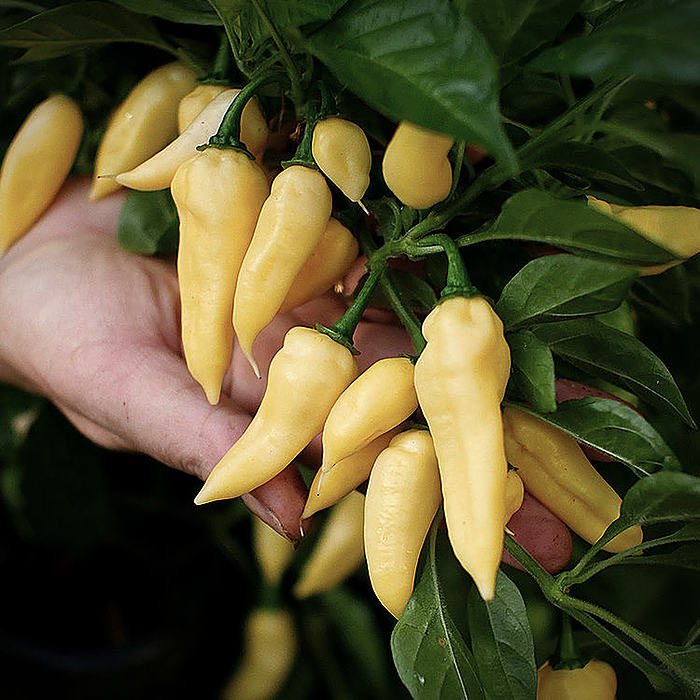
The plant groans under its own haunting — pale pods crowd the stem like spirits clinging to their host
In fact, it was one of the earliest to fruit in my greenhouse last year — cool spring or not. One customer, down in the south of England, even sent me photos of Wraiths grown outdoors. The plants were huge, dripping with pods. I wouldn’t recommend trying that in most places, but still — the fact it was possible tells you something about this variety’s adaptability. It’s a rare thing: a superhot that behaves.
WRAITH: noun.
A ghost or spectral figure, often seen just before or just after death. An apparition. A pale, drifting presence that haunts a place or person with silent intent.
But it’s when the pods start to ripen that the name truly earns its place. They don’t blush red or purple or orange. They don’t deepen or darken. They pale. Bone-pale. A soft, ghostly cream that doesn’t quite seem natural. During the day, they look odd but harmless — fat little lanterns with an almost decorative innocence. But come dusk, they change. I’d close up the greenhouse and notice them glowing faintly in the half-light. Not frightening, exactly. But once the word Wraith settles into your brain, they start to feel slightly haunted.
Wraith. It doesn’t arrive. It appears.
▶ Heat (Hotness): 7. The Wraith doesn’t shout. It leans in. The burn is immediate and strangely civilised — like being stabbed with a letter opener at a garden party. You won’t scream, but you might blink too much. There’s a moment — brief, uncertain — when you think it’s over. Then it spreads. Slowly, deliberately, like the chill in a shuttered nursery where something once wept itself into the walls. It isn’t pain exactly. It’s surrender. You’ve let it in, and now it lives in you — quiet, watchful, and waiting for the next time you forget who you were.
▶ Sweetness: 3. There’s a reserved, almost courtly sweetness here — the kind that knocks before entering. Think dried apricot with the colour faded, or the brittle glaze on a toffee apple abandoned on Bonfire Night. It’s not sugar-forward, but it’s there — enough to soften the chilli’s more violent urges. If the Wraith were a person, it would offer you a sweet from its pocket just before pushing you into the void.
cFruitiness: 5. Half a mango with the joy wrung out. There are fruit notes, but they’re spectral — fleeting hints of apricot, dried cherry, maybe even a whiff of black grape. It’s as if the fruit is hiding behind a curtain, occasionally leaning out to see if the coast is clear. It never is. You taste them most clearly just before the heat takes hold — a fleeting innocence before the reckoning.
▶ Texture (Firmness): 6. The pod is firm but not forbidding — a waxy skin with a clean snap, like a freshly lacquered fingernail. There’s density to it, enough to feel satisfying under the knife, but not so thick as to resist cooking. Slice it open and you’ll find an orderly chaos inside: glossy seeds, a pale placenta, and an unsettlingly clean interior, like a well-maintained surgical theatre.
▶ Juiciness: 4. This is measured juiciness — deliberate, not exuberant. The flesh holds a low-simmering reservoir of slightly oily liquid, which emerges slowly, like a secret. It doesn’t gush, but it spreads, ensuring the heat and flavour are broadcast with uncanny efficiency. Wipe your fingers and the scent remains — a lingering, peppery resin that clings like intent.
▶ Aftertaste (Complexity): 7. Here the Wraith earns its name. The flavour lingers like a memory — a dry heat around the molars, a hint of charcoal and dried herbs. There’s a whisper of something woody — sandalwood or maybe clove — and a tang that could be fermented plum or very old wine. It doesn't shout, it murmurs. But it stays. Hours later, you’ll catch yourself tasting it again, and wondering if it ever really left — or just decided to haunt you more quietly.
Botanically speaking, the Wraith is a chinense through and through — a cross most likely involving ghost pepper genetics, with fruits that often top out between 800,000 and 1,000,000 SHU. That places them comfortably above habanero heat, but still shy of the real million-plus monsters.
I’ve never once picked one and felt short-changed. In fact, the first time I harvested mine, I’d left them a bit too long. The plant had produced such a ridiculous crop that the branches had started to droop under the weight, and I kept putting off the harvest just to enjoy the sight of it.
By the time I picked them, they were slightly wrinkled, aged like small forgotten moons. They still blew my head off.
It’s not just heat, though. The flavour has something brittle and refined about it — not fruity in the usual way, but dry, with the faintest hint of sharpness, like the memory of stone fruit or the peel of something preserved. The pods are firm and neat, not overly juicy, and the heat arrives quickly, without drama, and then lingers just long enough to make you wonder if something’s changed.
For all their ethereal charm, the plants are solid and generous. Give them a hoop support — they’ll need it — and keep them in a greenhouse or tunnel if you’re north of Brighton. In a good year, they’ll reward you with an armful of strange, elegant, and possibly cursed fruit.
Just don’t be surprised if you start to behave a little differently around them. If you find yourself checking the plants more often than necessary. If you dream of bone-pale lanterns. If you hesitate — just for a moment — before picking the last pod. It may not be clear what the Wraith wants. But it’s in your garden now. And it has time.
Not Quite of This World – Try The Wraith.
Think you’ve seen every kind of chilli? The Wraith doesn’t shout. It waits. Bone-pale and eerily refined, it ripens without colour and bleeds red through the stem. Strange, elegant, and just dangerous enough to change you. Grow it if you dare!
World of Chillies was set up by Sarah Hunt in 2011 to promote chilli growing and the enjoyment of everything hot and spicy.
UK Company No. 07860204.
VAT reg. 223126942
▶ 1. Heat (Hotness): The defining characteristic for most people. Is it mild, medium, or hot? How does the heat develop—immediate or lingering?
▶ 2. Sweetness: The balance of natural sugars. Some chillies have a sweetness that complements their heat and makes them versatile in cooking.
▶ 3. Fruitiness: The aromatic, flavour-forward profile. Does it taste tropical, citrusy, or like berries? This quality often gives chillies their distinctive edge.
▶ 4. Crunchiness or Firmness (texture): Freshness matters. Is the chilli crisp and crunchy, soft and pliable, or somewhere in between?
▶ 5. Juiciness: How much moisture does the chilli release when bitten into? This can influence its suitability for fresh eating or cooking.
▶ 6. Aftertaste (Complexity): What lingers after the initial bite? Is there a smokiness, an earthiness, or a clean, simple finish? This separates "nice" chillies from truly memorable ones.
▶ Schedule of Dispatches . We’re pleased to let you know that we’re preparing to dispatch our first plug plants!. Please follow the link for a rough schedule, but please note that we’ll send your order once everything in it is ready. This ensures you receive the best possible plug plants—so if there’s a slight delay, rest assured you haven’t been forgotten. ▶ MORE INFORMATION